
Why Treating the Jaw May Not Be Enough - Myofascial Release for TMJ
If you have TMJ pain, you probably spend a lot of time thinking about your jaw.
Maybe it hurts when you chew. Maybe your jaw feels tight or tired. Maybe you wake up with sore muscles around your face, or you've noticed clicking, popping, headaches, or tension that seems to travel into your neck.
And naturally, you think, "Something must be wrong with my jaw."
But what if the jaw isn't the whole story?
Your Jaw Doesn't Work Alone
The temporomandibular joints (TMJs) are certainly an important part of the picture, but your jaw is connected to a much larger system of muscles, fascia, and movement patterns.
The muscles you use to chew and move your jaw are connected to the face, head, neck and shoulders. Your posture, breathing patterns, stress, and the way you hold tension throughout your body can all influence how those tissues feel and function.
That's one reason TMJ problems can be so frustrating.
You may focus on the place that hurts, while the contributing tension may be somewhere else.
This is why I take a whole-person approach when working with someone experiencing TMJ pain or dysfunction.

Sometimes the Best Place to Start Isn't the Place That Hurts
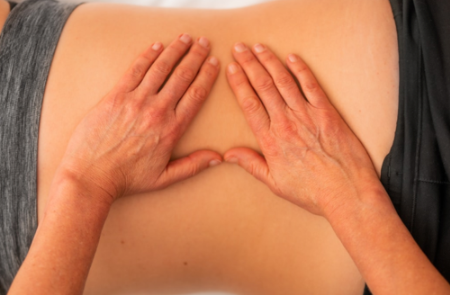
When someone comes to me for an in-person Dynamic Myofascial Release session, I don't simply focus on the jaw because that's where they're experiencing symptoms.
Instead, I look at the bigger picture.
Where are you holding tension?
How are your head, neck and shoulders positioned?
What happens when you breathe?
Are you clenching your jaw without realizing it?
Are there areas of restriction or tension in the surrounding tissues that may be influencing how your jaw moves?
With Myofascial Release, the goal isn't to force tissues into a particular position or aggressively stretch an area until it "lets go."
It's about listening to the body and giving restricted tissues the time and gentle pressure they need to soften and release.
And sometimes, the place where you feel the release isn't the place where you felt the pain.
That's one of the things I love about this work.
What Does the Research Say for Myofascial Release for TMJ
?
We're continuing to learn more about conservative approaches to treating TMD. The National Institute of Dental and Craniofacial Research recognizes self-management and nonsurgical approaches, including physical therapy and manual therapy, among the options that may be considered for TMD.
Research specifically examining myofascial release and related soft-tissue techniques for muscle-related TMD has also found potential improvements in pain and mouth function, although researchers note that more high-quality research is still needed.
In other words, we're continuing to learn that sometimes Myofascial Release for TMJ can be less can be more when it comes to working with the jaw.
Gentle. Conservative. Patient-centered.
And, importantly, looking beyond the jaw itself.
But What If You Don't Live in San Diego?
This is a question I've thought about a lot.
I love being able to work with people in person and use my hands to assess and treat areas of tension and restriction. There's something incredibly valuable about that one-on-one experience.
But I also know that not everyone lives in San Diego—or has the ability to come in for an in-person session.
That doesn't mean you're out of options.
Option 1: Find an MFR Therapist Near You
If you'd like to experience hands-on Myofascial Release but don't live in the San Diego area, you can search for a John F. Barnes-trained Myofascial Release therapist near you, and, through the John F. Barnes Myofascial Release Therapist Directory at MFRTherapists.com. (not everyone who is trained by John Barnes is on the directory)
The directory is specifically for therapists trained in the John F. Barnes Myofascial Release Approach, and you can search by location and other criteria. The directory also recommends taking your time, asking questions, and finding a therapist who has experience addressing your particular concerns.
One thing I'd encourage you to ask about is their experience working with TMJ and jaw-related tension.
Not every MFR therapist specifically focuses on TMJ—and that's okay.
Myofascial Release is a whole-body approach, so you may still find tremendous value in working with a practitioner on the rest of your body's fascial system.
Option 2: Learn to Work With Your Jaw at Home
You can also learn gentle self-treatment techniques that allow you to work with your own jaw and surrounding tissues between—or instead of—in-person sessions.
That's one of the reasons I created TMJ Let Go.
TMJ Let Go is an online self-treatment program designed to teach you gentle techniques you can practice at home, on your own schedule.
The program includes guided techniques for areas such as the jaw, face, neck and surrounding tissues. You don't need a room full of equipment or fancy gadgets. You simply need yourself, a little time, and a willingness to pay attention to what your body is telling you.
And if you find an MFR therapist in your area who doesn't specifically focus on TMJ, the two approaches can complement each other beautifully.
You can receive whole-body hands-on Myofascial Release locally while using TMJ Let Go to learn gentle, jaw-specific self-treatment techniques at home.
You don't necessarily have to choose one or the other.
Whether You're Across Town—or Across the Country
If you're local to San Diego and would like personalized, hands-on treatment, I'd love to work with you at Dynamic Myofascial Release.
If you're not local, you have options.
You can find a John F. Barnes-trained MFR therapist through the MFR Therapist Directory, learn gentle self-treatment techniques through TMJ Let Go, or combine the two.
Because your jaw is part of your body—not separate from it.
And sometimes, finding relief means looking beyond the place that hurts.
Relax. Release. Restore.
Not in San Diego?
Explore TMJ Let Go to learn gentle self-treatment techniques you can practice at home, on your own schedule.
Or, if you're looking for hands-on Myofascial Release, visit MFRTherapists.com to find a John F. Barnes-trained practitioner in your area.


Comments